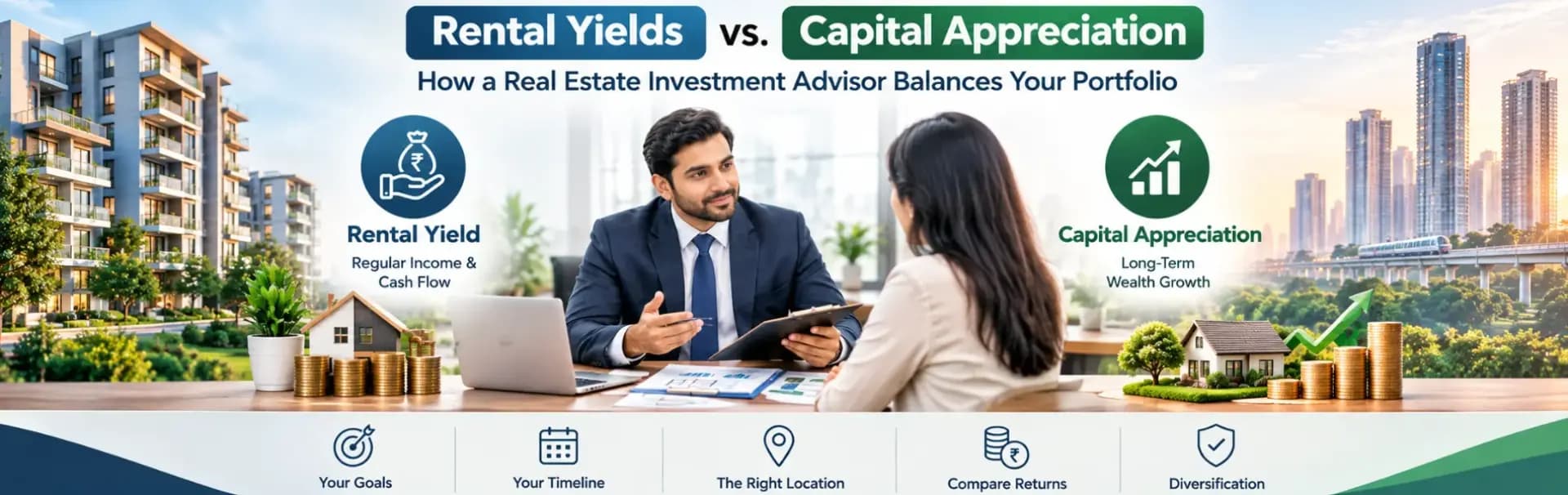
When investing in real estate, earning money can happen in two main ways. You can earn regular rental income, or you can benefit from an increase in the property's value over time.
These are commonly known as rental yield and capital appreciation.
While rental income can provide regular cash flow, capital appreciation can help grow your wealth over the long term. But which one should you focus on?
The answer depends on your financial goals, investment timeline, budget, and risk tolerance. This is where a Real Estate Investment Advisor can help. What Is Rental Yield? Rental yield tells you how much rental income a property generates compared with its value. For example, suppose you purchase a property for ₹50 lakh and receive ₹20,000 per month in rent. Your annual rental income would be ₹2.4 lakh. The gross rental yield would be: ₹2.4 lakh ÷ ₹50 lakh × 100 = 4.8% However, this is a simple calculation. Actual returns may be lower after considering maintenance charges, property taxes, vacancy periods, repairs, and other expenses. Why Do Investors Look at Rental Yield? Rental income can provide a regular source of cash flow. It may be useful for investors who: - Want periodic income - Prefer cash flow from their investments - Are looking for income after retirement - Want to offset some property-related expenses - Prefer a relatively predictable income stream However, rental income is not guaranteed. A property may remain vacant or require unexpected repairs. What Is Capital Appreciation? Capital appreciation refers to the increase in a property's market value over time. For example, if you purchase a property for ₹60 lakh and its value increases to ₹85 lakh after several years, the property has appreciated by ₹25 lakh. Capital appreciation is generally more relevant to investors with a long-term investment horizon. Property prices can increase due to factors such as: Better infrastructure Improved connectivity Development of business hubs Population growth Increasing demand Limited supply New transport projects Development of schools, hospitals, and retail areas However, property prices can also remain flat or decline depending on market conditions. Rental Yield vs. Capital Appreciation Both strategies have their own advantages. The important thing is that you don't always have to choose one over the other. Why Balance Matters A property that provides high rental income may not necessarily experience the highest appreciation. Similarly, a property in an emerging location may have strong appreciation potential but generate relatively low rental income in the early years. This is why balancing the two can be useful. For example, an investor may choose one property in an established commercial or residential area for rental income and another in a developing location with long-term growth potential. A real estate advisor can help identify opportunities based on these different objectives. How a Real Estate Investment Advisor Balances Your Portfolio A good Real Estate Investment Advisor will first understand what you want from your investment. 1. Understanding Your Financial Goals Are you looking for monthly income? Or are you primarily interested in growing your wealth over the next 10 years? Your answer can influence the type of property and location you should consider. 2. Looking at Your Investment Timeline If you need income in the near future, rental yield may be more important. If you can keep your money invested for several years, capital appreciation may play a bigger role. Your investment horizon should therefore be considered before choosing a property. 3. Evaluating the Location Location is one of the most important factors in real estate. An established area with offices, schools, transportation, shopping, and other facilities may have strong rental demand. On the other hand, an upcoming area with new infrastructure may offer potential for future appreciation. A property investment advisor can compare these factors before recommending a location. 4. Comparing Rental Yield With Property Price A high monthly rent does not always mean a good rental investment. For example, two properties may generate similar rent, but one may have a much higher purchase price. Investors should compare the annual rental income with the total investment cost and account for expenses. 5. Considering Diversification Putting all your money into one property can concentrate your risk. Depending on your budget, you may consider diversifying across different property types or locations. For example, your portfolio could potentially include residential property for rental income and commercial or emerging-location property for long-term appreciation. Diversification does not eliminate risk, but it can help avoid depending entirely on one property or market segment. Which Is More Important: Rental Yield or Capital Appreciation? There is no universal answer. If your primary goal is regular cash flow, rental yield may be more important. If your primary goal is long-term wealth creation, capital appreciation may have greater importance. For many investors, the ideal approach is a combination of both. The key is to select properties where the expected income and growth potential match your overall investment plan. Common Mistakes Investors Should Avoid Real estate investors sometimes focus only on the property's expected price increase or monthly rent. Some common mistakes include: Ignoring maintenance costs Not accounting for vacant periods Overlooking property taxes and other expenses Buying only because a location is popular Ignoring the property's legal documentation Assuming property prices will always increase Focusing only on advertised rental yields Investing without considering their overall portfolio Professional guidance can help investors look beyond the headline numbers. Final Thoughts Rental yield and capital appreciation are two important parts of real estate investing. Rental yield can provide regular cash flow, while capital appreciation can support long-term wealth creation. Instead of treating them as competing strategies, investors can consider how both fit into their overall portfolio. An experienced Real Estate Consultant can help you assess properties based on rental potential, appreciation prospects, location, expenses, market conditions, and your personal investment goals. The right strategy is not necessarily about finding the property with the highest rent or the highest expected appreciation. It is about finding the right balance for your financial objectives. Before investing, conduct proper due diligence and consider seeking advice from a qualified property investment advisor who understands the local market. Frequently Asked Questions 1. What is rental yield in real estate? Rental yield is the annual rental income generated by a property compared with its purchase or market value. It is usually expressed as a percentage. 2. What is capital appreciation in property? Capital appreciation is the increase in a property's value over time. Investors generally benefit from this increase when they sell the property, although the value can fluctuate. 3. Is rental yield better than capital appreciation? Neither is automatically better. Rental yield may be more suitable for investors seeking regular income, while capital appreciation may appeal to investors focused on long-term wealth creation. 4. What is a good rental yield for a property? There is no single rental yield that can be considered good for every property. It depends on the location, property type, purchase price, expenses, market conditions, and investment objective. 5. How can I calculate rental yield? A simple gross rental yield calculation is: Annual Rental Income ÷ Property Value × 100 For a more realistic estimate, investors should also consider maintenance, taxes, vacancy periods, repairs, and other expenses. 6. How does location affect capital appreciation? Location can have a major impact on property demand and prices. Connectivity, infrastructure, employment opportunities, amenities, and future development can all influence appreciation potential.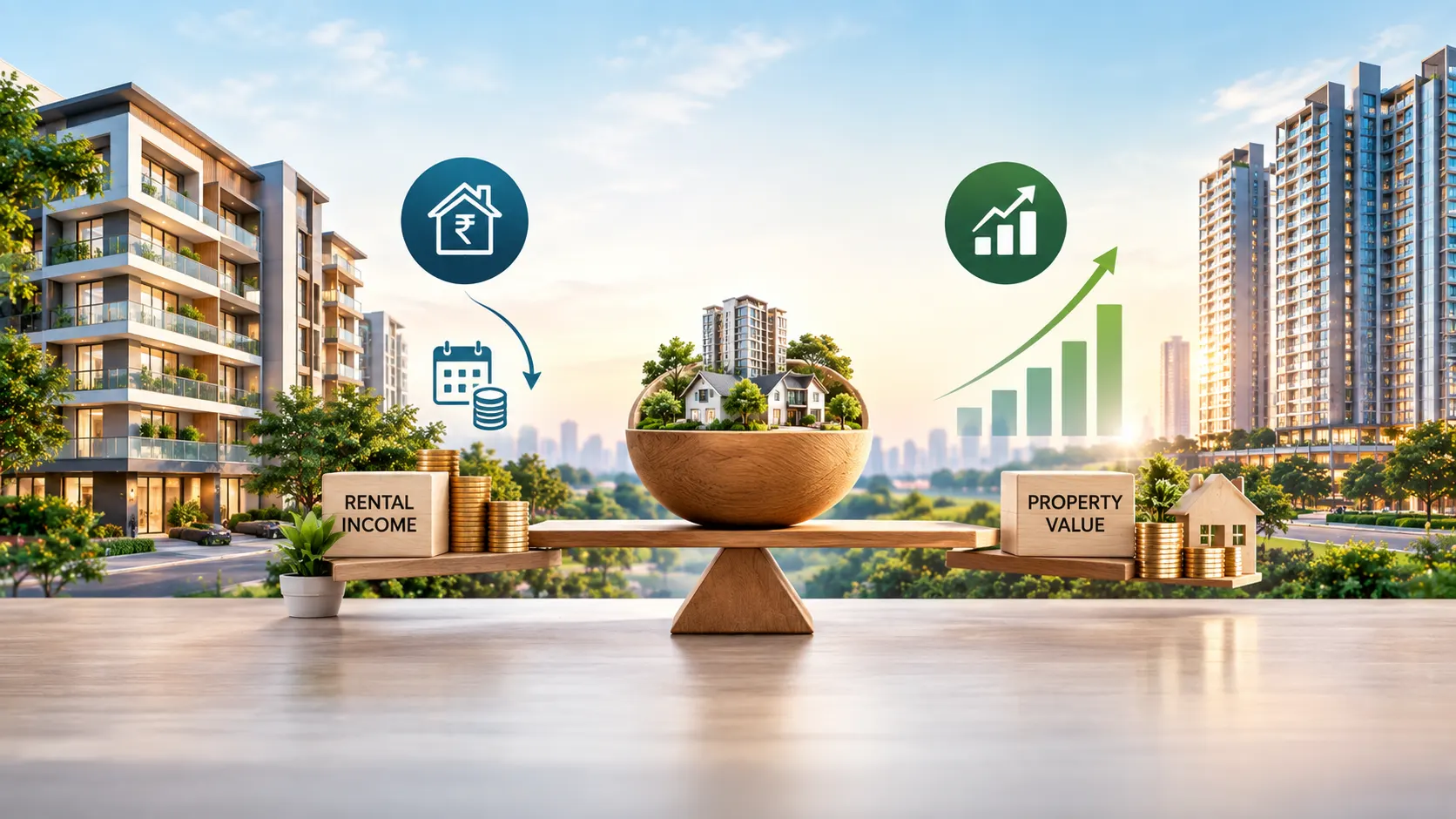
The residential Real Estate Buyer...Read more

Kalpataru Vista is a new premium...Read more

Change your lifestyle, change Your...Read more

Jewar Airport is an Noida International...Read more

Noida has become one of...Read more

Gurgaon‘s Golf Course...Read more


Connecting the corners of the...Read more

It's that time of the...Read more

Metaverse real estate is one...Read more

Are you looking for ways...Read more

Budget 2023 - The projects...Read more

The process of buying and...Read more

The Delhi–Mumbai Expressway is a 1,386 km...Read more

The commercial real estate sector...Read more

The Uttar Pradesh cricket association...Read more

Nestled in the lush greenery...Read more


Introduction

The Read more

Noida has rapidly become one...Read more

Noida’s real estate market has...Read more

Noida is no...Read more

The Read more


Noida...Read more

Why You...Read more




Read more




A...Read more





Read more





Read more




Read more

Read more


Read more



Read more



Read more

Read more


Noida...Read more





Find your dream property with trust, quality, and the
perfect match for your needs.

Office Address
303, Tower 4, Assotech Business Cresterra,
Sector 135 Noida, Uttar Pradesh, India 201305

Contact
+91 9582-211-311

Email Us
info@propcasa.com