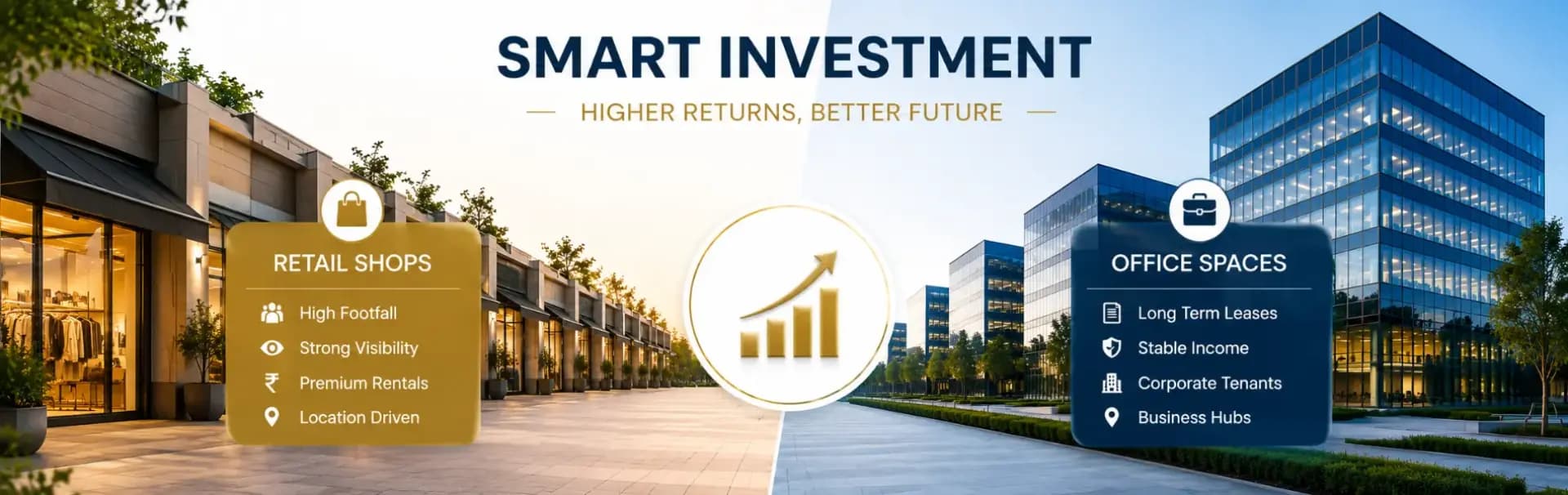
Commercial real estate can be an attractive option for investors looking beyond residential properties. Among the many commercial property options available, retail shops and office spaces are two popular choices.
Both can generate rental income and offer the potential for capital appreciation. However, they work differently and come with their own advantages and risks.
So, if you are planning to invest in commercial property, which one should you choose: a retail shop or an office space?
There is no single answer. Your decision should depend on your budget, location, expected rental income, investment period, and risk appetite. A Real Estate Investment Advisor can help you compare these factors and understand which option may fit your investment goals.
What Is Commercial ROI?
Commercial ROI, or Return on Investment, refers to the return you earn from a commercial property compared with the money you have invested.
For example, if you purchase a property for ₹1 crore and generate rental income from it, you can calculate the rental return against your investment. You can also consider any increase in the property's value over time.
However, ROI is not just about the rent you receive. Expenses such as maintenance, taxes, vacancy periods, brokerage, property management, and financing costs can affect your actual returns.
This is why investors should look at the complete picture before buying a commercial property.
Investing in Retail Shops
Retail shops are usually located in areas where there is regular customer movement. This could include high streets, shopping centres, commercial markets, malls, or mixed-use developments.
A well-located retail shop can benefit from strong footfall and demand from businesses such as restaurants, salons, grocery stores, pharmacies, fashion outlets, and other retailers.
One of the biggest attractions of retail property is the possibility of rental income. A shop in a high-demand location may attract tenants who are willing to pay a premium for visibility and customer access.
However, location is extremely important. A retail shop with poor visibility or low footfall may struggle to attract tenants, even if the property itself looks attractive.
Investing in Office Spaces
Office spaces are generally leased to businesses, startups, professionals, and corporate companies.
Demand for office spaces is closely connected to employment growth, business activity, connectivity, and the development of commercial hubs.
An office property in a well-established business location may attract companies looking for convenient access to employees, clients, transportation, and other business facilities.
Office spaces can also offer longer lease arrangements depending on the tenant and property. This may provide investors with relatively stable rental income when the property has a good tenant and location.
However, office demand can change with economic conditions, changes in working patterns, and the supply of competing office spaces.
Which Offers Better Rental Income?
Rental income depends heavily on the property and location rather than simply whether it is a shop or office.
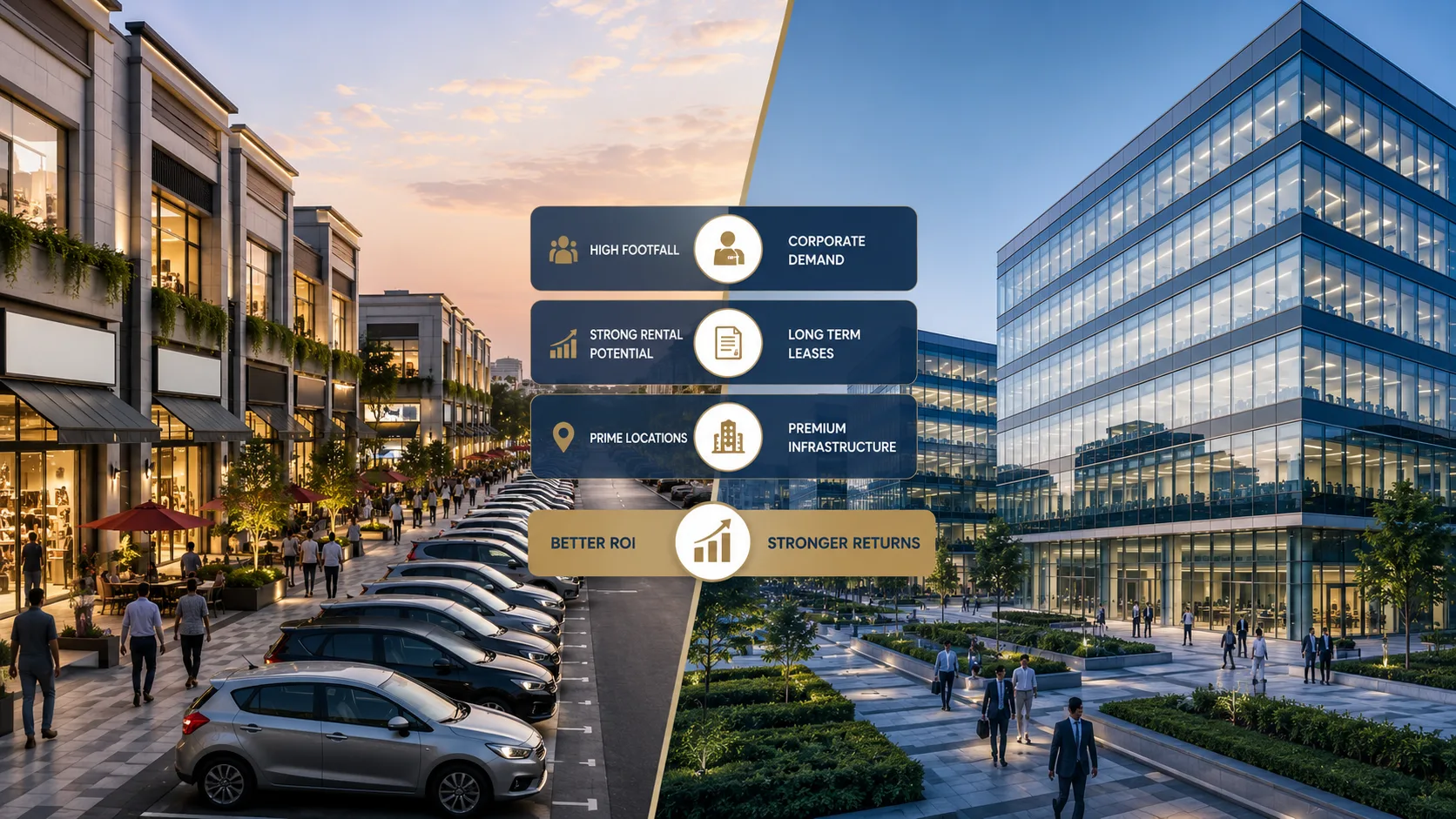
A retail shop in a busy commercial area can potentially command strong rent because businesses value visibility and customer footfall.
An office space in a major business hub can also generate attractive rent, especially when there is strong demand from companies.
Instead of looking only at the monthly rent, investors should calculate the rental yield.
For example, a property generating ₹6 lakh in annual rent on a ₹1 crore investment has a gross rental yield of 6%.
But this is only a basic calculation. Actual returns can be lower after considering vacancy, maintenance, taxes, brokerage, and other expenses.
A property investment advisor can help you calculate the potential net return more realistically.
The Importance of Location
Location is one of the most important factors in commercial real estate.
For retail shops, factors such as footfall, visibility, parking, nearby residential areas, accessibility, and surrounding businesses can have a major impact on demand.
For office spaces, factors such as connectivity, public transportation, parking, nearby residential areas, business ecosystem, and accessibility for employees and clients can be more important.
This is why two properties of the same size can have completely different rental potential.
A good real estate advisor will generally look beyond the property itself and study the surrounding market before recommending an investment.
Tenant Demand Matters
A commercial property is only valuable as an investment if businesses want to occupy it.
Before buying, investors should understand who the potential tenants are and whether there is enough demand in that location.
For a retail shop, ask whether there are enough customers and businesses in the area.
For an office, consider whether companies are actually looking for space in that particular business district.
You should also look at existing vacancy levels and competing properties nearby.
Vacancy Risk
Vacancy is one of the biggest risks in commercial real estate.
If a retail shop remains vacant for several months, you may have to continue paying maintenance and other property-related costs without receiving rent.
The same applies to office spaces.
A property that offers high advertised rental returns may not be a good investment if it regularly remains vacant.
Therefore, investors should consider realistic occupancy rather than assuming that the property will always have a tenant. Retail Shops and Long-Term Appreciation Retail properties can appreciate when the surrounding area becomes more commercially active. Improved roads, new residential projects, better connectivity, increasing population, and higher customer activity can support demand. A retail shop in an established high-footfall location may also benefit from limited availability of similar spaces. However, appreciation is never guaranteed. Investors should avoid buying a shop solely because they expect prices to rise in the future. Office Spaces and Capital Appreciation Office properties can also appreciate as commercial hubs grow. The development of business parks, IT corridors, transportation infrastructure, and new corporate offices can increase demand for commercial space. However, investors should consider whether the office property remains attractive to tenants over the long term. Building quality, amenities, parking, accessibility, and the overall business environment can influence both rental demand and resale value. Which Is More Suitable for You? A retail shop may be worth considering if your primary focus is rental income and you are comfortable investing in a location where customer footfall and visibility are strong. An office space may be more suitable if you prefer exposure to established business districts and demand from companies and professionals. Your budget also matters. Instead of asking, “Which property gives the highest return?” a Real Estate Investment Advisor may first ask, “Which investment fits your financial goals and risk level?” This is an important distinction because a property with a high expected return may also come with higher vacancy or other risks. What a Real Estate Investment Advisor Looks At Before recommending a commercial property, an experienced Real Estate Investment Advisor may evaluate the purchase price, expected rent, rental yield, location, tenant demand, vacancy levels, maintenance expenses, lease terms, financing costs, and resale potential. They may also look at the future development of the area. For example, a new metro connection or business hub could influence future demand. Similarly, an oversupply of commercial properties could put pressure on rents. This type of analysis can help investors make decisions based on more than just the property's advertised price or rental return. Common Mistakes to Avoid One common mistake is buying a commercial property only because the promised rental yield looks attractive. Another mistake is ignoring vacancy risk. Investors should also avoid assuming that every commercial property will appreciate quickly. The quality of the building, location, tenant demand, and overall market conditions matter. It is also important to understand the lease agreement, maintenance responsibilities, taxes, applicable charges, and other costs before investing. Final Thoughts Retail shops and office spaces can both be valuable additions to a commercial real estate portfolio. Retail shops may benefit from customer footfall and visibility, while office spaces are generally driven by business activity and corporate demand. Neither option is automatically better. The right choice depends on the property's location, purchase price, rental potential, tenant demand, vacancy risk, expenses, and your investment goals. A real estate advisor can help you compare these factors and understand the potential ROI before you commit your money. Most importantly, don't judge a commercial property only by its promised rental income. Look at the complete investment picture and consider both potential returns and risks. Frequently Asked Questions 1. Are retail shops better than office spaces for investment? Not necessarily. Retail shops may offer strong rental potential in high-footfall locations, while office spaces can benefit from demand in established business areas. The better option depends on the specific property and your investment goals. 2. Which has better rental yield, retail or office space? Rental yield varies significantly by location, property type, tenant demand, and purchase price. There is no fixed rental yield that applies to all retail or office properties. 3. What is commercial property ROI? Commercial property ROI measures the return generated from a commercial property compared with the amount invested. Rental income and capital appreciation can both contribute to overall returns. 4. What factors affect commercial property ROI? Purchase price, rental income, vacancy, maintenance costs, taxes, financing costs, location, tenant demand, lease terms, and future appreciation can all affect ROI. 5. Is location important for retail shops? Yes. Footfall, visibility, accessibility, parking, nearby residential areas, and surrounding businesses can strongly influence the demand for a retail shop. 6. Is office space a good investment? Office space can be a suitable investment when there is strong demand from businesses in the area. However, investors should carefully evaluate vacancy levels, tenant demand, location, and ongoing costs.

The residential Real Estate Buyer...Read more

Kalpataru Vista is a new premium...Read more

Change your lifestyle, change Your...Read more

Jewar Airport is an Noida International...Read more

Noida has become one of...Read more

Gurgaon‘s Golf Course...Read more


Connecting the corners of the...Read more

It's that time of the...Read more

Metaverse real estate is one...Read more

Are you looking for ways...Read more
Budget 2023 - The projects...Read more

The process of buying and...Read more

The Delhi–Mumbai Expressway is a 1,386 km...Read more

The commercial real estate sector...Read more

The Uttar Pradesh cricket association...Read more

Nestled in the lush greenery...Read more


Introduction

The Read more

Noida has rapidly become one...Read more

Noida’s real estate market has...Read more

Noida is no...Read more

The Read more


Noida...Read more

Read more




Read more




A...Read more





Read more





Read more



Read more

Read more


Read more



Read more



Read more

Read more


Noida...Read more




Read more






Read more




Find your dream property with trust, quality, and the
perfect match for your needs.

Office Address
303, Tower 4, Assotech Business Cresterra,
Sector 135 Noida, Uttar Pradesh, India 201305

Contact
+91 9582-211-311

Email Us
info@propcasa.com